
ABOUT THE AUTHOR
Most men spend their entire lives and do not achieve a fraction of what the author can list as his accomplishments, in his first 20 years since leaving college.
Kurt W. Donsbach, Ph.D., D.Sc., N.D., D.C. was born December 1, 1935 in Kalispell, Montana and was raised on a ranch 12 miles west of Whitefish, Montana. It was on that ranch that he had a chance to start the development of his keen sense of nature and natural healing--in a way that only comes from truly living with what nature can produce.
A prolific student of nutrition and natural healing in college, Dr. Donsbach hungered for the opportunity of more sophisticated research and experimentation not available in a large country practice, so he accepted a position with the world renown Dr. Royal Lee of the Lee Foundation of Nutritional Research in Milwaukee, Wisconsin in 1961. The Lee Foundation, famous the world over for its findings on national malnutrition and its effects on health, provided the ideal opportunity for additional specialized studies, enabling Dr. Donsbach to develop and test his theories and thus substantiate his recommendations for preventive organic medicine.
After a long and personal relationship with Dr. Lee, the author moved to Southern California to establish his own health food store and began Westpro Labs., Inc. and with his lovely wife Elyse, developed the company into a national supplier of special and unique food supplement formulations.
At WESTPRO, Dr. Donsbach at last had the laboratory he always wanted to continue his research and study of preventive organic medicine. He and his products gained national recognition due to Dr. Donsbach being such a strong advocate of extremely high standards for nutritionally sound formulations.
Long a respected author on organic medicine and natural healing, Dr. Donsbach has written several books including "Preventive Organic Medicine" as well as hundreds of papers and articles for journals and magazines, plus several courses in nutrition.
Since 1964 Dr. Donsbach has been honored by serving on the Board of Governors of the National Health Federation, first as its Secretary-Treasurer, then its Vice-President and now as Chairman of the Board.
Others might be content to rest on their laurels with all this success, but in 1973 Dr. Donsbach sold Westpro Labs and later enrolled in a Ph.D. program in Nutrition from Union University of Los Angeles. At that point he decided that bringing a better understanding to the public on nutrition and natural healing is where he should be devoting his energies. He then with other doctors interested in this same philosophy established THE INTERNATIONAL INSTITUTE of NATURAL HEALTH SCIENCES, Inc. (see back cover). He is President and Dean of Faculty of Donsbach University, an external degree program in Nutrition--the first such program ever to be offered.
ACKNOWLEDGEMENT
The information presented in this booklet would not have been available if it were not for the generous contribution of my long time friend and colleague, Dory Detton, N.D. who furnished much counsel and advice. Dr. Detton, who has had quite a colorful career--including a title as a world champion wrestler (before television took that sport over) and an insatiable thirst for knowledge, now lives in semi-retirement in Ouray, Colorado, but still teaches seminars in nutrition and other health related topics in various areas. Years ago, his was a familiar figure around the countryside of Utah and Idaho where he made personal calls on farmers and ranchers, teaching them the use of food supplements, diet, and herbs to protect their health.
SCLEROLOGY
The examination of the sclera or white of the eye and the interpretation of the lines or blood vessels seen there is an ancient art passed on from one healer to the other. Although there has been much inferred about the lack of scientific background of this art, you might talk to your local veterinarian and see if the white of the eye of his patient does not tell him much about the condition present in his mute supplicant. Much also has been said about acupuncture and its lack of science, but the individual who observes major surgery accomplished without the use of anesthetics often becomes a believer without the benefit of science.
So it is with sclerology. I have observed individuals proficient in this form of correlation of body malfunction with visible signs in the sclera of the eye enough times to convince myself beyond a shadow of doubt that it is valid. But since I like to know the reason why, I spent some time with my anatomy and physiology books to try and find a correlation between the sclera and the indications of malfunction it presented. I finally found that the tissues of the sclera are continuous with the dura mater of the brain via the fibrous sheath of the optic nerve. This to me was an adequate link to give a physiological and anatomical reason for the relationship.
REAL LIFE TEST
Let me tell you of a real life test that occurred not too long ago regarding sclerology. A personal friend who is in the entertainment industry and quite well known had me 'read' the sclera of his eyes. He was overwhelmed with the accuracy of the description of his physical well being. On telling this to an attorney friend, he was challenged. The attorney friend said that he had just undergone over $1,000 worth of examination and diagnostic procedures which were necessitated by a problem which seemed to be difficult to trace. However, after the testing, the doctors were able to pinpoint the cause of his discomfort. Would I consent to 'read' his sclera and see if I could find the same things that the elaborate tests had found.
It took about two minutes to examine the sclera of both eyes and I told him that it appeared that there was a kidney malfunction and a lower bowel problem, but that the kidney seemed to be the more serious of the two. He was flabbergasted--the tests had indicated he suffered from a rather rare kidney malady and had diverticulosis of the bowel. At this point I wish to emphasize that sclerology is not an exact science, but it is a quick easy method of determining where a potential problem is within our body. It does not name a disorder--only that a malfunction exists in an area or gland.
SCLEROLOGY IS NOT IRIDOLOGY
Under no circumstances should sclerology be confused with iridology, the art of interpreting the changes within the iris or colored portion of the eye. This practice takes much study and is tedious work for an accurate evaluation. Sclerology is comparatively simple and superficial in its application. A doctor can use it as a guide to perform additional detailed examination procedures, eliminating those which do not have to be done.
Dr. Clarence Patrick (Sundance) Hathaway, a half-Apache, half-Irish medicine man is the source of the charts found in this booklet. Dr. Dory Detton spent eight years working with this secretive old medicine man who was considered a miracle healer by Indian and white man alike. His medicines were herbs and unprocessed foods and his diagnostic instruments were confined to a penlite to assist him in examining the sclera of the eye.
In examining the sclera of the eyes, remember that the sclera which is on your right is the left sclera of the individual you are examining, and vice versa. The lines in the right sclera are indicative of conditions on the same side of the body, hand, foot and head with the exception of the brain area. There is a crossover of the areas of the head above the supra-orbital ridge, the right eye sclera then shows the left brain problems and the left eye sclera demonstrates right brain problems.
TECHNIQUE
In reading or examining the sclera, use the iris (colored portion of eye) as a guide like the face of a clock and examine in a clock-wise direction. You will soon learn to visualize the charts presented herein and if you always examine in the same pattern, the visualization and interpretation will be easier. You will find that the use of a light and a low power magnifying glass will make your examination easier. Some combination instruments are available for this purpose at a reasonable cost.
RIGHT EYE SCLERA
Begin by gently pulling downward on the right lower eyelid
and instructing the individual to look straight upward. Examine the areas listed
below; if a line is present, it is indicative of a stressed condition in the
corresponding area. Remember, it's like looking at a watch with only an hour hand.
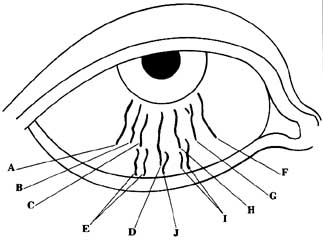
| 4:30 | Sciatic nerve problem in right leg |
| 5:00 | Prostate or Vagina (usually indicates hardening or dryness) |
| 6:00 | Right kidney or adrenal involvement |
| 6:30 | Pancreas problem |
| 7:00 | Ovaries or Testes |
| 7:30 | Liver or gall bladder congestion |
By examining the chart on the opposite page, you will find that the above are those lines nearest the iris of the eye. There are often
other lines which are in the lower portion of the sclera and usually do not run close to the iris.
| 5:30 Small intestine |
This may indicate milk intolerance, impaired absorption of nutrients because of plugged up villi, rapid peristalsis, etc. |
| 6:00 Transverse colon |
Both of these colon indications are often a sign of constipation, colitis, diverticulitis, or an atonic, congested bowel. |
| 6:30 Ascending colon |
Both of these colon indications are often a sign of constipation, colitis, diverticulitis, or an atonic, congested bowel. |
(Looking Up)
|
A - LIVER, GALL BLADDER B - OVARY OR TESTES C - PANCREAS D - UTERUS E - ASCENDING COLON F - SCIATIC NERVE G - PROSTATE OR VAGINA H - KIDNEY & ADRENAL I - SMALL INTESTINE J - TRANSVERSE COLON |
RIGHT EYE SCLERA
(Looking Right)
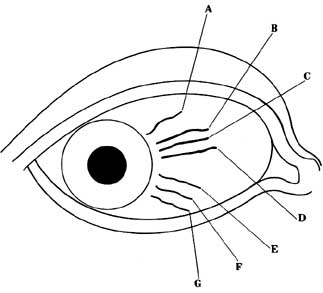
Have the individual open his eyes wide and look to his right for this part of the examination.
| 1:00 Tonsils, Throat |
This usually means either an acute or chronic infection, maybe tonsillitis or strep throat. If no such evidence is present, there possibly is a latent infection that is not evidencing itself readily. |
| 2:00 Thyroid |
Most of the time this will be indicative of a low functioning thyroid. |
| 2:30 Trachea |
This line is not often seen, but should be heeded when evident. |
| 3:00 Esophagus |
This can be indicative of an irritation due to slight regurgitation of partly digested food into the esophagus. Check digestion. |
| 4:00 Upper Back |
All of these three back areas are only indicative of the area where a problem may exist, they are not specifically diagnostic. |
| 4:30 Middle Back |
All of these three back areas are only indicative of the area where a problem may exist, they are not specifically diagnostic. |
| 5:00 Lower Back |
All of these three back areas are only indicative of the area where a problem may exist, they are not specifically diagnostic. |
(Looking Right)
|
A - TONSILS, THROAT B - THYROID C - TRACHEA D - ESOPHAGUS E - UPPER BACK F - MIDDLE BACK G - LOWER BACK |
RIGHT EYE SCLERA
(Looking Down)
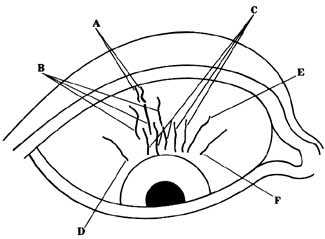
Gently lay your thumb on the closed upper eyelid and roll
it upward while you tell the individual to look straight down at his right foot.
| 10:00 Right Ear or Mastoid |
Can be an injury, infection, or even an indication of deafness |
| 11:00 to 11:30 Sinusitis |
The more lines here the more severe sinus problem you have. These lines will be about midway in the sclera. |
| 11:00 to 12:00 Nervous Disorder (lines will be close to iris) |
A prime indicator of nervous stress and strain, these lines will also be more or less congested and numerous depending on severity. |
| 1:00 Right Eye |
May indicate impending or existing glaucoma, cataract, or other eye problem. |
| 2:00 Nose |
Often seen in conjunction with chronic sinus or rhinitis condition, but can indicate an old or new injury. |
(Looking Down)
|
A - BRAIN CONCUSSION OR INJURY B - SINUSITIS C - NERVOUS DISORDERS D - EAR MASTOID AREA E - EYE F - NOSE |
RIGHT EYE SCLERA
(Looking Left)
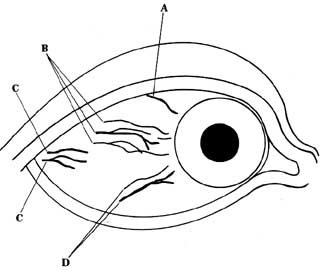
Keeping the eye open wide, instruct the individual to look toward his other eye--it is important that he not look at his nose.
| 10:30 Neck or Right Ear |
This may indicate injury, loss of hearing or infection. |
| 9:30 to 10:00 Lung Congestion |
The more lines which appear in this area, the more you will note the intensity of the congestion. |
| 7:30 Congestion of Thorax |
This will usually indicate a more serious edema in the generalized area and should be dealt with as soon as possible. |
| 9:00 Bursitis or Injury to Right Shoulder |
RIGHT SCLERA
(Looking Left)
|
A - NECK (OR) EAR B - LUNG CONGESTION C - BURSITIS OR INJURY TO SHOULDER (RIGHT) D - CONGESTION OF THORAX |
LEFT EYE SCLERA
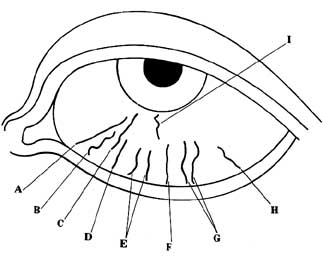
(Looking Up)
Begin by gently pulling downward on the left lower eyelid and instructing the individual to look straight upward.
Examine the areas listed below; if a line is present, it is indicative of a stressed condition.
| 8:00 Prostate or Uterus |
Usually indicates a hardened prostate gland or a boggy uterus, but may also indicate surgery to either of these two organs. |
| 7:45 Hemorrhoids |
These can usually be differentiated by the very typical wavy line they produce. The heavier the line, the more serious the problem. |
| 7:15 Left Adrenal (closer to iris) |
Usually indicates low function. Check for allergies, arthritis, hypoglycemia, fatigue, headaches. |
| 7:00 Left Kidney (farther from iris) |
May be malfunctioning, infected or overworked. |
| 6:30 Small intestine |
This may indicate milk intolerance, impaired absorption of nutrients because of plugged up villi, rapid peristalsis, etc. |
| 6:15 Stomach-- (close to iris) |
Often indicates poor digestion, lack of enzymes, possible predisposition to ulcers, low hydrochloric acid content, etc. |
| 6:00 Colon |
May indicate constipation, colitis, diverticulitis, or an atonic congested bowel. |
| 5:30 Descending Colon& Rectum |
Almost always constipation. |
| 4:30 Spleen |
A sluggish, atonic spleen can create real problems in blood quality. |
(Looking Up}
|
A - PROSTATE OR UTERUS B - HEMORROIDS C - ADRENAL D - KIDNEY E - SMALL INTESTINE F - COLON G - DESCENDING COLON H - SPLEEN I - STOMACH |
LEFT EYE SCLERA
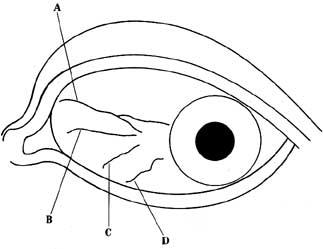
(Looking Left)
Have the individual open his eyes wide and look to his left for this part of the examination.
| 9:45 Thyroid |
Most of the time this will be indicative of a low functioning thyroid. |
| 9:00 Upper Back 8:00 Lower Back |
If lines appear between these areas it can indicate middle back problems. Again, these are not specific diagnostic signs, but area signs. |
| 7:00 Sciatic Nerve problem in left leg. |
(Looking Left)
|
A - THYROID B - UPPER BACK C - LOWER BACK D - SCIATIC NERVE |
LEFT EYE SCLERA
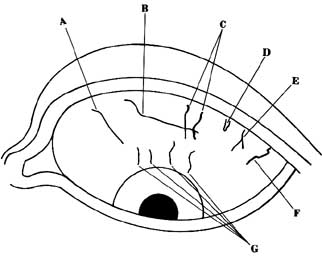
(Looking Down)
Gently lay your thumb on the closed upper eyelid and roll it upward, while you tell the individual to look straight down at his or her left foot.
| 11:00 Eye Problems |
Often indicates cataracts or glaucoma. |
| 11:30 and running transverse Epilepsy |
A very unusual line and easy to spot. |
| 12:30 Sinus Problems |
The more lines, the more congestion present. |
| 1:00 Brain Concussion |
This line or lines will be very close to the edge of the sclera and will indicate a serious blow to the head at some time. |
| 2:00 Brain Tumor |
We often suspect tumor activity when we see a y shaped line. |
| 2:30 Left Ear and Mastoid |
May indicate loss of hearing, infection or injury. |
| 11:45 to 1:00 Brain Malfunction |
May also indicate severe nervous stress and or tension. |
(Looking Down)
|
A - CATARACTS / GLAUCOMA B - EPILEPSY C - SINUS D - BRAIN CONCUSSION E - BRAIN TUMOR F - EAR PROBLEMS G - BRAIN MALFUNCTION |
LEFT EYE SCLERA
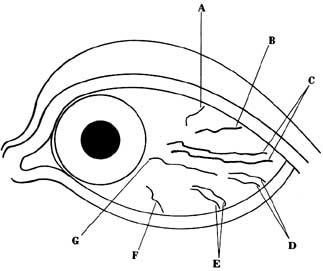
(Looking Right)
Keeping the eye wide open, instruct the individual to look
toward his other eye--it is important that he not look at his nose.
| 6:00 Spleen |
A sluggish atonic spleen can create real problems in blood quality. |
| 5:00 History of Rheumatic Fever |
These individuals may not even be aware that they have had rheumatic fever — check their heart for possible damage. |
| 4:00 Bursitis or Injury to Left Shoulder |
May be acute or chronic. |
| 3:00 Lung Congestion |
The more lines and the heavier they are the more serious is the lung congestion. |
| 2:30 Neck Area |
|
| 1:30 Left Ear and Mastoid |
May indicate loss of hearing, infection, or injury. |
| 4:00 Heart-- (close to iris) |
May indicate weakness, previous problem or impending problem. The heavier the line, the more serious. |
(Looking Right)
|
A - EARS B - NECK C - LUNG CONGESTION D - BURSITIS E - HISTORY OF RHEUMATIC FEVER F - SPLEEN G - HEART |
BOOKLET TITLES YOU WON'T WANT TO MISS*
*The Soil and Health Library would like to make these long out-of-print and valuable titles available. If any patron possesses one or more of them, please contact us.
The following books have been published by the INSTITUTE to date:
ALLERGIES
ARTHRITIS
CHOLESTEROL
BLOOD PRESSURE
HERBS BOOK 1
HERBS BOOK 2
MENOPAUSE
ACNE
NATURAL SUBSTITUTES FOR COMMON DRUGS
HEART ATTACK AFTER HYSTERECTOMY
HYPOGLYCEMIA
OVERWEIGHT
EXERCISE
VITAMINS
MINERALS
PROSTATE
BEAUTY
SCLEROLOGY
STRESS CANCER
Look for the following titles to come out in the near future:
DIABETES
HEADACHE
DIGESTIVE DISORDERS
SINUSITIS
WATER
VARICOSE VEINS & HEMORRHOIDS
PREGNANCY
ULCERS
Look for these topics at your local health food store or book store as they are published. We invite you to submit topics which may interest you for future books.